"The thought process was: 'How do we consume as much of your time and conscious attention as possible?' And that means that we needed to sort of give you a little dopamine hit every once in a while because someone liked or commented on a photo or a post or whatever. It's a social validation feedback loop... exactly the kind of thing that a hacker like myself would come up with, because you're exploiting a vulnerability in human psychology."
Those are not the words of a whistleblower. They are the words of Sean Parker, Facebook's founding president, speaking at an Axios event in November 2017. He was not apologizing. He was explaining. "God only knows what it's doing to our children's brains," he added.
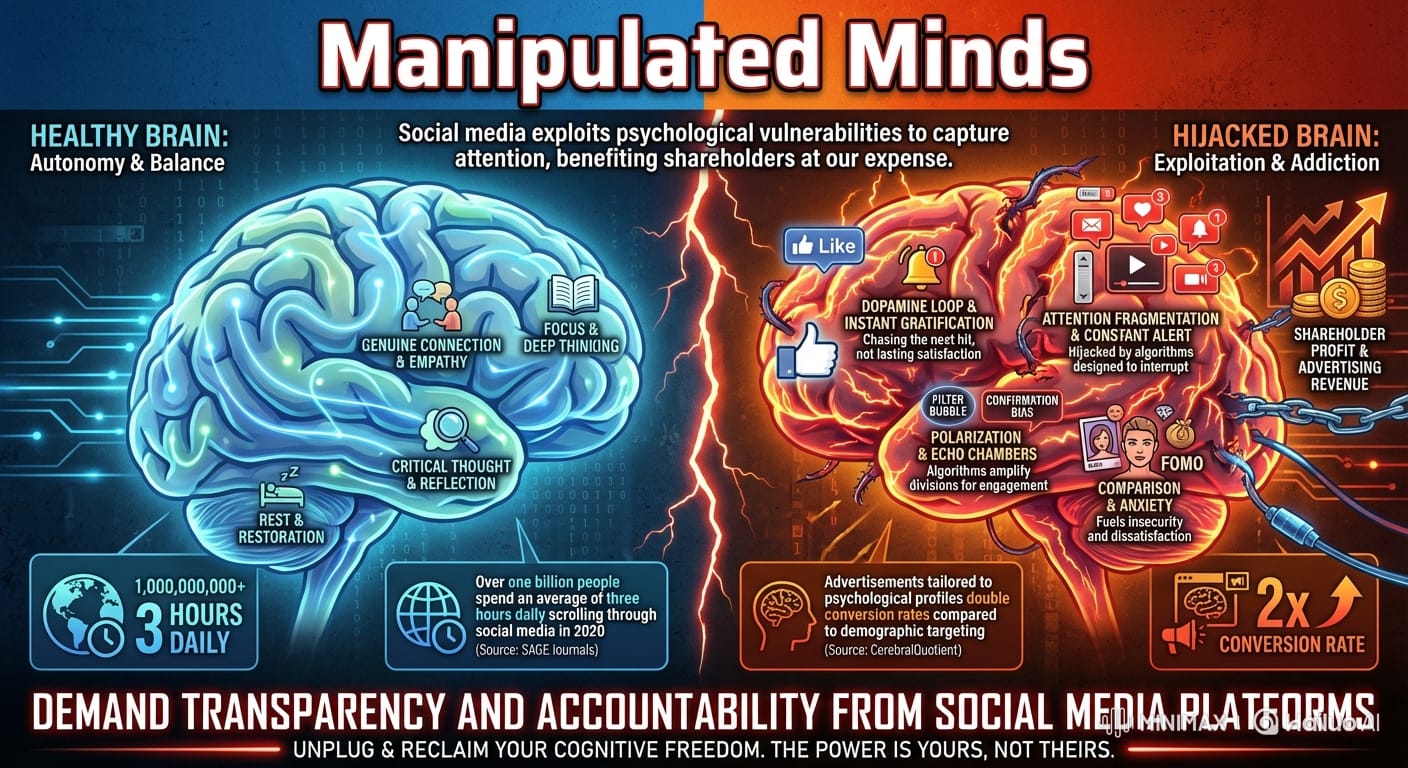
The numbers are stark. Over one billion people spent an average of three hours daily scrolling through social media in 2020. Advertisements tailored to psychological profiles double conversion rates compared to demographic targeting. The molecular pathways activated by social media engagement parallel those of substance addiction. And the business model that exploits these vulnerabilities generates over $200 billion annually in advertising revenue for Meta alone.
This article traces how techniques originally developed for military psychological operations found their way into your smartphone. How academic research on persuasion became the foundation of trillion-dollar business models. And why regulators have fined platforms billions, yet the manipulation continues.
The platforms are not broken. They are working exactly as designed.
The military connection

From battlefields to newsfeeds
The term "psychological operations" carries the weight of military history. The U.S. Army defines PSYOP as sharing specific information to foreign audiences to influence emotions, motives, reasoning, and behavior. PSYOP soldiers learn advanced social media and marketing as core skills.
The parallel to commercial social media is not metaphorical. Research published in academic journals describes how social networking sites have presented psychological operations with a modern medium that amplifies their operational capacity. Through strategic dissemination of information, PsyOps intend to override objective reasoning of a target, in favor of a predetermined outcome.
The technique is the same whether the target is a foreign population or a potential customer. Only the product being sold differs.
The stanford laboratory
The academic foundation for commercial psychological manipulation was laid at Stanford's Persuasive Technology Lab, founded in 1998 by B.J. Fogg. The lab researched how computing products, from websites to mobile phone software, can be designed to change what people believe and what they do.
The Fogg Behavior Model became foundational: for a target behavior to occur, a person must have sufficient motivation, the ability to perform the behavior, and a trigger. These three factors must occur at the same moment.
This is not abstract theory. Instagram's co-founder was Fogg's student. The techniques taught in that lab now reach billions of users daily. But understanding behavior is only half the equation. The platforms also needed to understand which neural circuits to target.
The dopamine machine