
Part 2 of 3 in the "1984 → 2048: Europe's Choice" trilogy
"We are not interested in the good of others; we are interested solely in power."
— O'Brien to Winston Smith, 1984
Brexit and Trump weren't the attack. They were the rehearsal.
In 2016, Russian intelligence tested its weapons on the Anglosphere, and both targets fell. The troll farms worked. The funding pipelines worked. The division algorithms worked. Now the arsenal is aimed at the continent those operations were designed to isolate.
Europe is the real target. The siege has already begun.
In Part 1, we mapped the three digital superstates and their perpetual war. Now we turn to their primary battlefield: Europe.
The siege of Europe doesn't use tanks and missiles. It uses troll farms and bank transfers, compromised politicians and captured platforms. Russia has spent a decade cultivating far-right movements across the continent. America has built a surveillance infrastructure that treats European data as a resource to be extracted. China manufactures the hardware that enables both.
But Europe's greatest vulnerability isn't the superstates' aggression, it's Europe's own digital naivety. The continent that invented privacy as a human right has made itself utterly dependent on foreign platforms, foreign hardware, and foreign clouds.
In Orwell's 1984, Europe doesn't exist. It has been absorbed: the west into Oceania, the east into Eurasia. That absorption is happening now, in real time, through mechanisms Orwell never imagined.
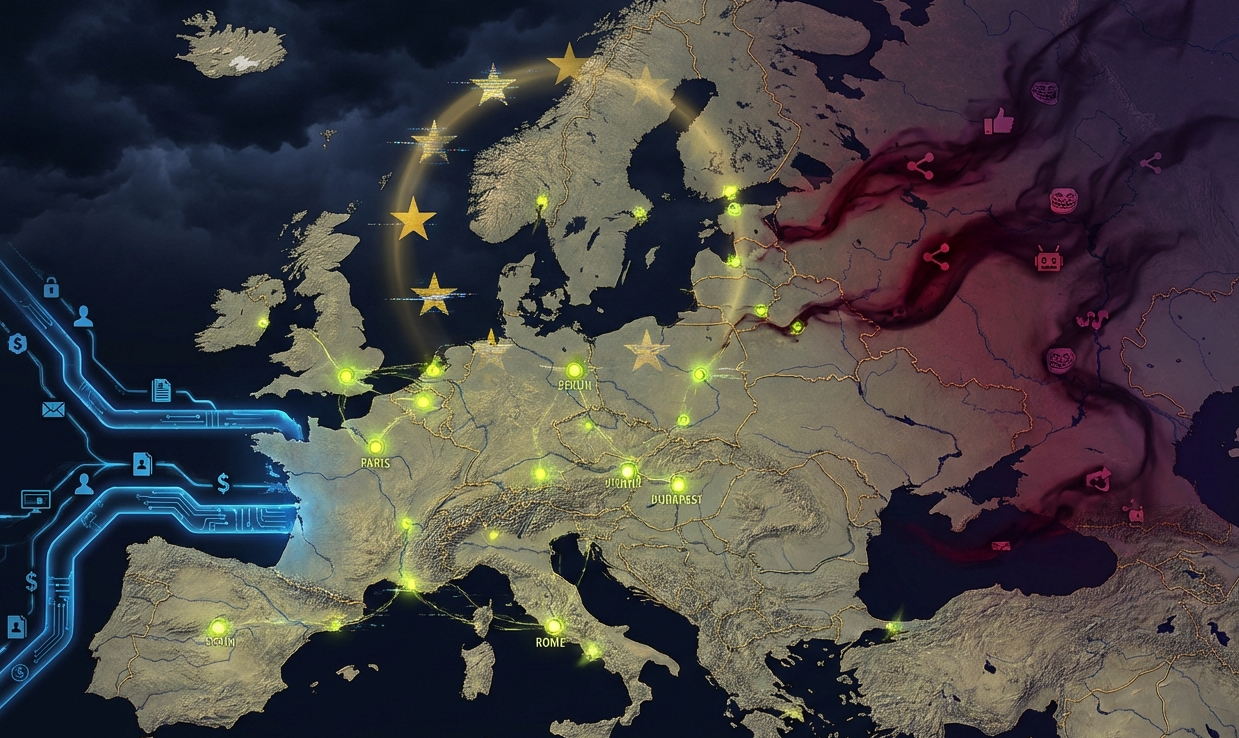
The long game: from Crimea to Cambridge to Kyiv
The documented strategy: divide and conquer
Russia's strategy to weaken Western unity is not speculation. It is doctrine. The "Gerasimov Doctrine" (named after Russian Chief of General Staff Valery Gerasimov) explicitly describes how information warfare, political subversion, and strategic ambiguity can achieve objectives that conventional military force cannot. The goal: fracture NATO and the EU before any shot is fired.
The timeline tells the story:
- 2014: Crimea - Russia annexes Crimea while the West responds with sanctions but no military intervention. The message: the West is divided and will not fight.
- 2016: Brexit & Trump - Both campaigns saw documented Russian interference. The U.S. Mueller Report confirmed the Internet Research Agency (IRA) operated "troll farms" targeting American voters. UK intelligence identified the same Russian actors attempting to influence the Brexit referendum.
- 2022: Ukraine - Full-scale invasion, betting that a divided West would fragment under economic pressure. The bet nearly worked.
This is not a conspiracy theory. The U.S. Intelligence Community's January 2017 assessment concluded with "high confidence" that Russian President Vladimir Putin "ordered an influence campaign" targeting the 2016 U.S. election. The Mueller Report documented "sweeping and systematic" interference by the IRA, which created fake American personas on social media and organized real-world rallies on both sides of divisive issues.
The European front: what we know
The troll farms go continental
The Internet Research Agency's operations targeted both the U.S. 2016 election and UK Brexit referendum simultaneously. The same St. Petersburg-based troll farm ran concurrent influence campaigns across Western democracies, creating fake personas, amplifying divisive content, and organizing real-world events on both sides of the Atlantic.
Following the money
Russian funding to European parties has been documented by the European Parliament's "Tip of the Iceberg" report. The French National Front (now RN) received €11 million in loans from Russian banks in 2014. Austria's FPÖ signed a formal "friendship agreement" with Putin's United Russia party in 2016. The money trail is not speculation; it is documented.
The German connection
AfD-Kremlin connections include documented meetings between party officials and Russian actors. In 2024, MEP Maximilian Krah was detained and questioned by the FBI over suspicions of receiving Kremlin funds through the Voice of Europe operation. German intelligence continues to monitor these contacts.
Caught on camera
The Ibiza Scandal of 2019 captured Austria's FPÖ vice-chancellor on video discussing political donations from someone claiming to be a Russian oligarch's niece. The footage exposed the eagerness for Kremlin money at the highest levels of European politics. The vice-chancellor resigned within days.
What remains unproven
Cambridge Analytica's role in Brexit remains contested. While documentaries have presented compelling narratives linking the data firm's Brexit work to its later Trump campaign involvement, the UK Information Commissioner's investigation found "no significant breaches" by the firm in the Brexit referendum context. The connection is plausible but not proven to the same standard as Internet Research Agency operations.
Direct coordination between Brexit, Trump campaigns, and the Kremlin has not been established with the same evidentiary standard as Russian interference itself. The operations may have been parallel rather than coordinated. We should be careful not to see conspiracy where opportunism may suffice as explanation.
The rightward shift: coincidence or consequence?
Since 2020, the same pattern has played out across Europe's largest democracies.
Germany: the unthinkable returns
The AfD won 20.8% in the 2025 federal election, their best result ever. In September 2024, Thuringia became the site of the first far-right state election victory in Germany since World War II. Party leader Alice Weidel has explicitly cited Brexit as a model for "Dexit", Germany's exit from the European Union. Meanwhile, German intelligence warns of ongoing Russian cultivation of AfD contacts. The party that once seemed a fringe protest movement now shapes the national conversation.
France: Le Pen's long march
Marine Le Pen's Rassemblement National won 31.4% in the 2024 European Parliament elections, their highest share since 1984. The party now holds 125 seats in the National Assembly after the July 2024 snap elections—a historic breakthrough that would have been unimaginable a decade ago. Le Pen herself is currently barred from the 2027 presidential run due to an EU fund embezzlement conviction, but the movement she built has joined the Patriots for Europe group alongside Hungarian Fidesz and Austrian FPÖ, forming a continental bloc.
Austria: through the looking glass
The FPÖ won 28.8% in the 2024 parliamentary elections, their best result in history. Herbert Kickl has been tasked with forming Austria's first far-right-led government since World War II. A former intelligence chief warned that FPÖ in government would be "a considerable security problem" for international partners. The party maintains documented ties to Russia despite claiming its "friendship treaty" with Putin's United Russia has expired.
The pattern: EU-critical but not EU-exit
What makes the current shift strategically sophisticated is that these parties no longer explicitly call for EU exit. They learned from Brexit's chaos. Instead, they advocate for a "Europe of sovereign nations" rather than federalism, demanding "national priority" for citizens over EU residents. They push for opt-outs from common policies on asylum, climate, and defense. They assert the primacy of national law over EU law, despite treaty violations. And they work to block further EU integration and enlargement at every turn.
This is the 1984 strategy adapted for 2026: You don't need to physically conquer territory if you can hollow out the institutions from within.
Critical assessment: causation vs. correlation
Is the European rightward shift caused by Russian interference, or is Russia simply exploiting existing discontent? The honest answer: both, and the distinction matters less than we'd like.
What we know
Russian state actors have systematically funded, promoted, and coordinated with European far-right parties. These parties promote policies aligned with Russian strategic interests: weaken NATO, fragment the EU, end Ukraine support. The timing of Russian interference correlates with major electoral disruptions, from Brexit to Trump in 2016. Security services across Europe have issued warnings about far-right parties' Russian connections.
What we cannot prove
We cannot definitively prove that Brexit or Trump would not have happened without Russian interference. We cannot prove that Cambridge Analytica's techniques were developed on Brexit and then deployed for Trump. We cannot prove that there is a single coordinated "master plan" rather than opportunistic exploitation. Correlation is not causation, and intellectual honesty requires acknowledging the limits of our evidence.
The conclusion that matters
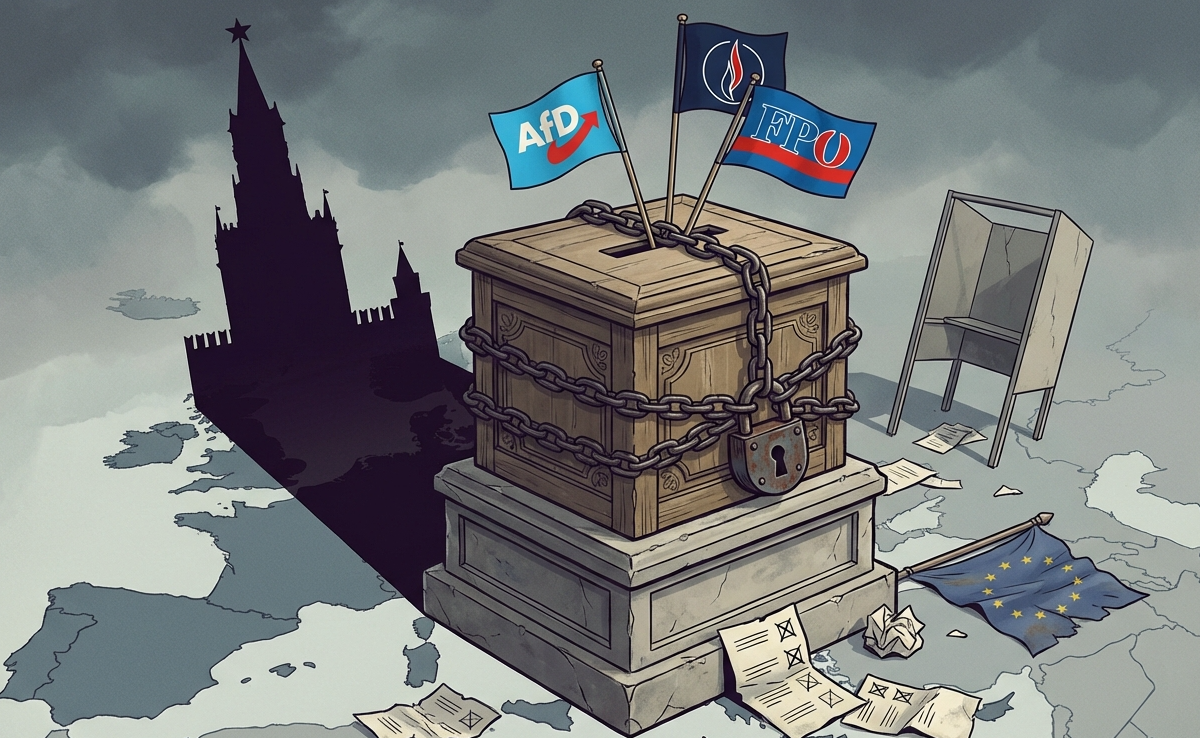
Whether or not Russia "caused" Europe's rightward shift, it has demonstrably amplified and exploited it. The parties most aligned with Russian interests are gaining power across the continent. The policies they promote would achieve Orwell's Eurasia outcome, European absorption into the Russian sphere, through democratic means rather than military conquest.
In 1984, Big Brother conquered through force. In 2026, the conquest can come through the ballot box.
The real vulnerability: European digital naivety
Here's what Europeans must confront: Russia didn't build the weapons it uses against us. We handed them over.
Russia's Internet Research Agency troll farms operated on American platforms (Facebook, Twitter, YouTube) that Europe adopted wholesale without building alternatives. The disinformation that fractures European unity flows through infrastructure we don't control, governed by algorithms we can't audit, owned by companies that answer to foreign courts.
This wasn't inevitable. Other regions made different choices.
South Korea, a country of 51 million people, built and maintained its own digital ecosystem. Naver dominates search with 63% market share (Google has just 31%). KakaoTalk is the universal messaging app: virtually every Korean uses it. Naver and Kakao together control over 70% of Korea's digital advertising market, forming what analysts call a "walled garden" that limits American platform dominance.
Japan built LINE with 186 million users across Asia, dominating messaging in Japan, Taiwan, and Thailand. Russia has VK (72 million users) and Telegram. China's ecosystem (WeChat with 1.28 billion users, Weibo, Douyin) is entirely domestic.
Europe could resist. With 450 million people and a €17 trillion economy, it had the market power to demand alternatives or build its own. It chose dependency.
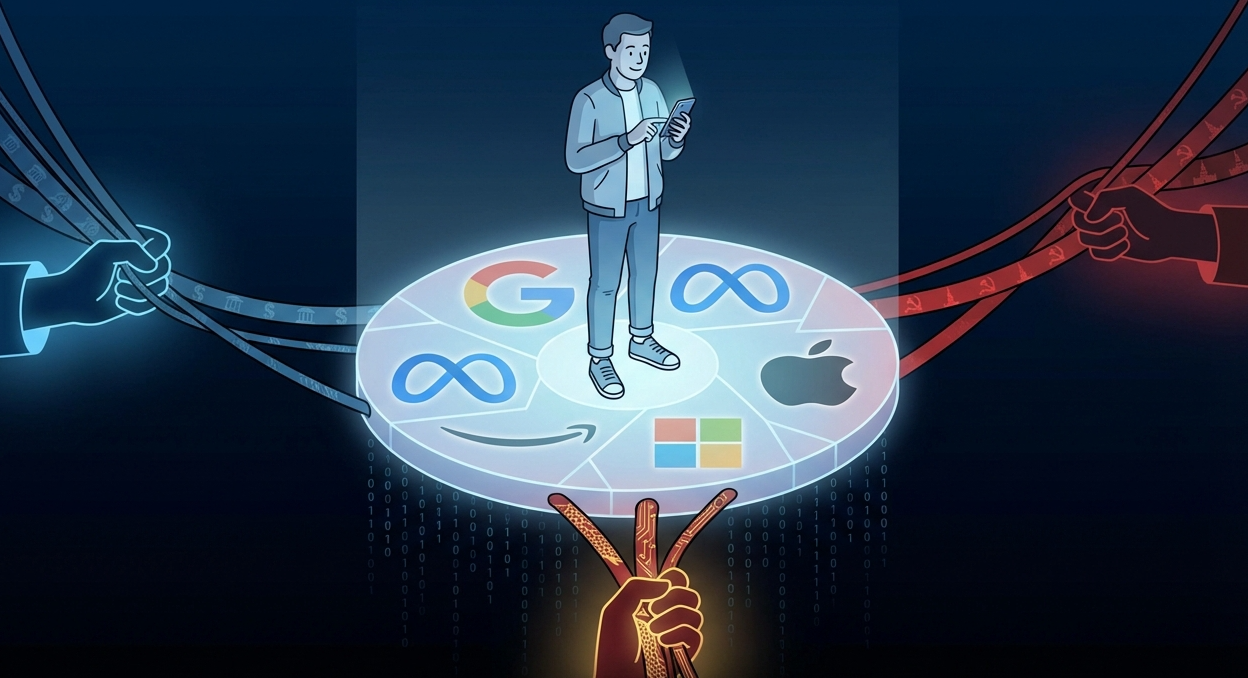
Russia is merely the most aggressive exploiter of a vulnerability that all three superstates recognize:
The three enablers of European weakness
1. Social Media Colonization - Europe has no major social platforms. Facebook has 308 million European users, TikTok 150 million. When Russian trolls, Chinese influence operations, or American political campaigns want to reach European citizens, they use American platforms that European regulators can fine but not fundamentally control. The DSA is a bandage on a severed limb.
2. Hardware Dependency - Europe designs chips (ASML's lithography machines are essential to every advanced processor), but manufactures almost none. Chinese factories build the phones in European pockets. The surveillance capabilities baked into hardware, whether Chinese backdoors feared by Western intelligence or American ones revealed by Snowden, exist in devices Europe cannot inspect at scale.
3. Cloud Subjugation - Seven out of every ten bytes of European data live on American servers. When Washington sneezes, Berlin's email goes down. When Amazon has a bad quarter, European startups lose their infrastructure. European data is subject to the CLOUD Act, accessible to American intelligence, governed by American law. When Microsoft can suspend the International Criminal Court's email, and AWS can deplatform any customer within 24 hours as it did with Parler, European sovereignty is revealed as a polite fiction.
The Superstates Don't Compete for Europe, they share it
| Vulnerability | American Exploitation | Russian Exploitation | Chinese Exploitation |
|---|---|---|---|
| Social media | Platform monopoly, data harvesting, algorithmic control | Disinformation campaigns, political manipulation | TikTok influence, propaganda amplification |
| Hardware | NSA-accessible devices, supply chain leverage | Limited (depends on Western tech) | Manufacturing dominance, potential backdoors |
| Cloud/Data | CLOUD Act access, surveillance infrastructure | Cyberattacks on European systems | Data requirements for market access |
| Surveillance model | Corporate extraction ("surveillance capitalism") | State-directed information warfare | State-corporate fusion, exported globally |
The question isn't whether Russia, America, or China poses the greater threat. The question is why Europe built a digital civilization on foundations it doesn't control.
Russia weaponizes European vulnerabilities. America monetizes them. China manufactures the hardware that enables both.
Europe's 1984 nightmare isn't being conquered by one superstate. It's being colonized by all three simultaneously, each taking the piece that serves its interests.
Europe's 1984 nightmare
In Orwell's world, Europe doesn't exist
This is not metaphor. Open 1984 and look at the map Orwell drew.
Oceania comprises the Americas, the British Isles, Australasia, and southern Africa. Eurasia spans the entire Eurasian landmass from Portugal to the Bering Strait. Eastasia covers China, Japan, and Southeast Asia.
Where is Europe?
Western Europe—France, Germany, the Low Countries, Scandinavia—is a perpetual warzone, fought over but never truly held. In the novel's backstory, Britain was absorbed into Oceania (the American sphere) in the 1950s. Continental Europe fell to Eurasia (the Russian sphere). The European civilization that gave the world the Enlightenment, human rights, and democratic governance simply... ceased to exist as an independent entity.
Orwell wrote this in 1948, projecting forward to 1984. He was describing the logic of superpower competition: small and medium powers get absorbed or destroyed. There is no room for a third way.
We are now living the test of whether Orwell was wrong.
The current trajectory: digital absorption in progress
The absorption Orwell imagined through military conquest is happening through digital dependency:
- Seven of every ten bytes of EU data live on American servers
- Energy dependence was Russian until 2022, and the pipelines can't be unbuilt overnight
- The phone in your pocket was assembled in China, from chips designed in America, running software that reports to both
- Your political opinions are shaped by American algorithms and disrupted by Russian operations
Europe in 2026: a digital colony caught between empires, each taking what it needs.
The "Pretty Version" of 1984
Orwell got one thing wrong: he assumed totalitarianism would be ugly.
In 1984, the Party rules through deprivation, fear, and violence. The telescreens are mandatory. The Two Minutes Hate is compulsory. Room 101 breaks the body to conquer the mind. The boot stamps on a human face, forever.
But history teaches a different lesson: empires built on violence eventually fall. Empires built on desire endure.
The Soviet Union fell because it could not provide what people wanted—consumer goods, freedom, opportunity. The American cultural empire spread through blue jeans, Coca-Cola, and Hollywood, things people chose to embrace. You cannot sustain an empire that only takes. The empires that last are the ones that give people what they desire, then extract value from the dependency they create.
In 2026, control wears a friendlier face:
| 1984 | 2026 |
|---|---|
| Telescreen (mandatory, watched you) | Smartphone (voluntary, you bought it, you carry it everywhere) |
| Two Minutes Hate (compulsory outrage) | Algorithmic feed (voluntary outrage, optimized for engagement) |
| Room 101 (torture with your deepest fear) | Dopamine loops (reward with your deepest desires) |
| Newspeak (vocabulary reduction) | Content curation (information bubbles, reality fragmentation) |
| Ministry of Truth (central propaganda) | Personalized reality (each user sees different "truth") |
| Thought Police (surveillance for dissent) | Predictive analytics (surveillance for profit and influence) |
| Boot on face (painful control) | Comfortable sneaker (frictionless submission) |
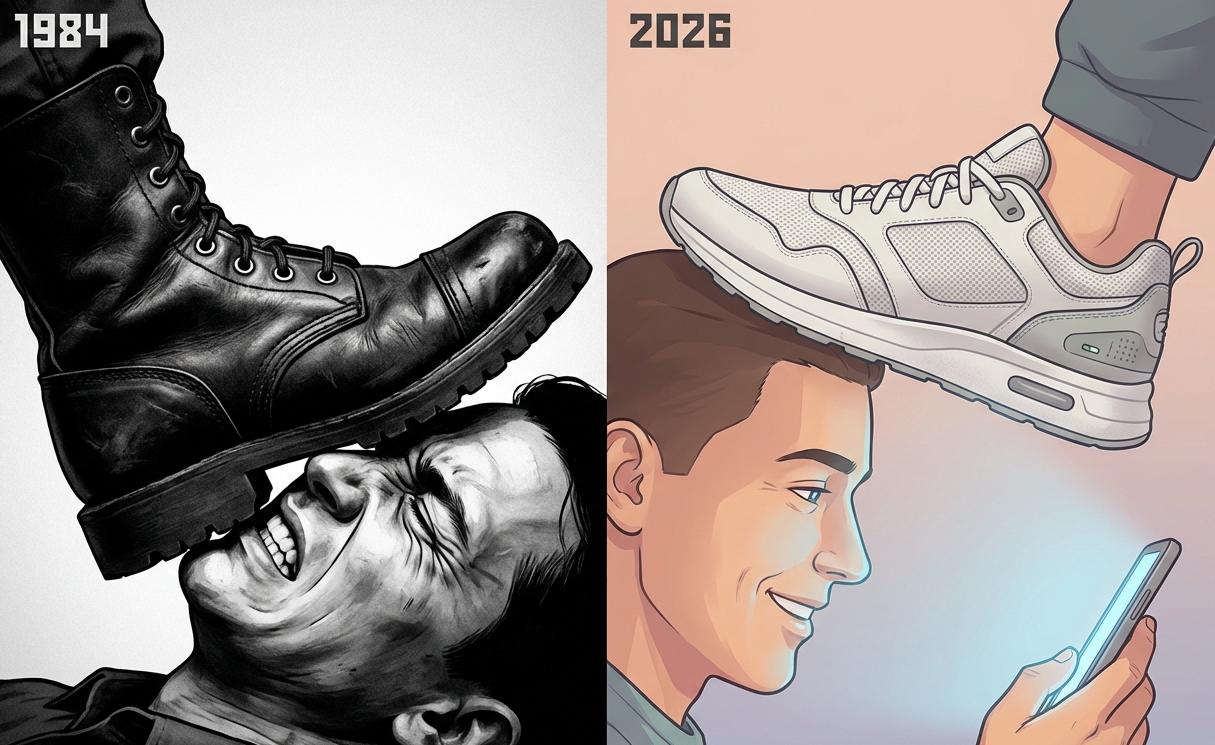
The Party understood that humans can be broken by pain. Silicon Valley discovered they can be captured by pleasure. The result is the same: a population that cannot think clearly, cannot act collectively, cannot resist effectively.
We are not tortured into compliance. We are entertained into it.
Doublethink in the digital age
In 1984, "doublethink" means holding two contradictory beliefs simultaneously and accepting both as true. War is Peace. Freedom is Slavery. Ignorance is Strength.
Each superstate practices its own version:
America declares privacy a fundamental right while operating PRISM, tapping Angela Merkel's phone, and passing the CLOUD Act to reach any data stored by American companies, anywhere in the world. Rules-based international order, except when American interests say otherwise.
China demands non-interference in its internal affairs while exporting surveillance systems to 80+ countries. The cameras that watch Uyghurs in Xinjiang now watch dissidents in Zimbabwe. Belt and Road promises "win-win cooperation", until Sri Lanka loses a port and Zambia offers its electrical grid as collateral.
Russia claims NATO expansion threatens its security while invading Georgia, annexing Crimea, and launching full-scale war against Ukraine. It justifies the invasion as "denazification" while employing the Wagner Group, whose founder displayed Nazi insignia. It demands information sovereignty while operating troll farms that flood Western social media with disinformation.
For Europeans, the challenge is not choosing the "good" side. There is no good side. Each superstate speaks of values while practicing power. Both surveil. Both extract. Both subordinate European interests to their own.
Winston Smith was taught to accept that 2 + 2 = 5 if the Party said so. Europeans are being asked to accept that surveillance is privacy, that dependency is partnership, that absorption is alliance.
The answer must be: No. We can count.
The siege is real. The walls are breached.
Russia cultivates politicians who would dismantle the EU from within. America extracts data through platforms we cannot control. China manufactures the devices we cannot inspect. And Europe—450 million people, €17 trillion in GDP—has made itself dependent on all three.
In Orwell's 1984, Winston Smith asks O'Brien what the future looks like. The answer: "A boot stamping on a human face, forever."
But that was the ugly version. The version that breeds resistance.
The 2026 version is different. The boot is a comfortable sneaker. The stamping is a gentle massage. The human face is scrolling, always scrolling, too entertained to notice what it has surrendered.
But Europe is not Oceania. Not yet.
In Part 3: The Fourth Way, we examine what Europe still possesses that Winston Smith never had: democratic institutions, regulatory power, 450 million citizens who can still choose.
Series context
Position: Part 2 of 3 in "1984 → 2048: Europe's Choice" trilogy
Previous: 1984 → 2048: The Three Digital Superstates (Part 1)
Next: 1984 → 2048: The Fourth Way (Part 3)
